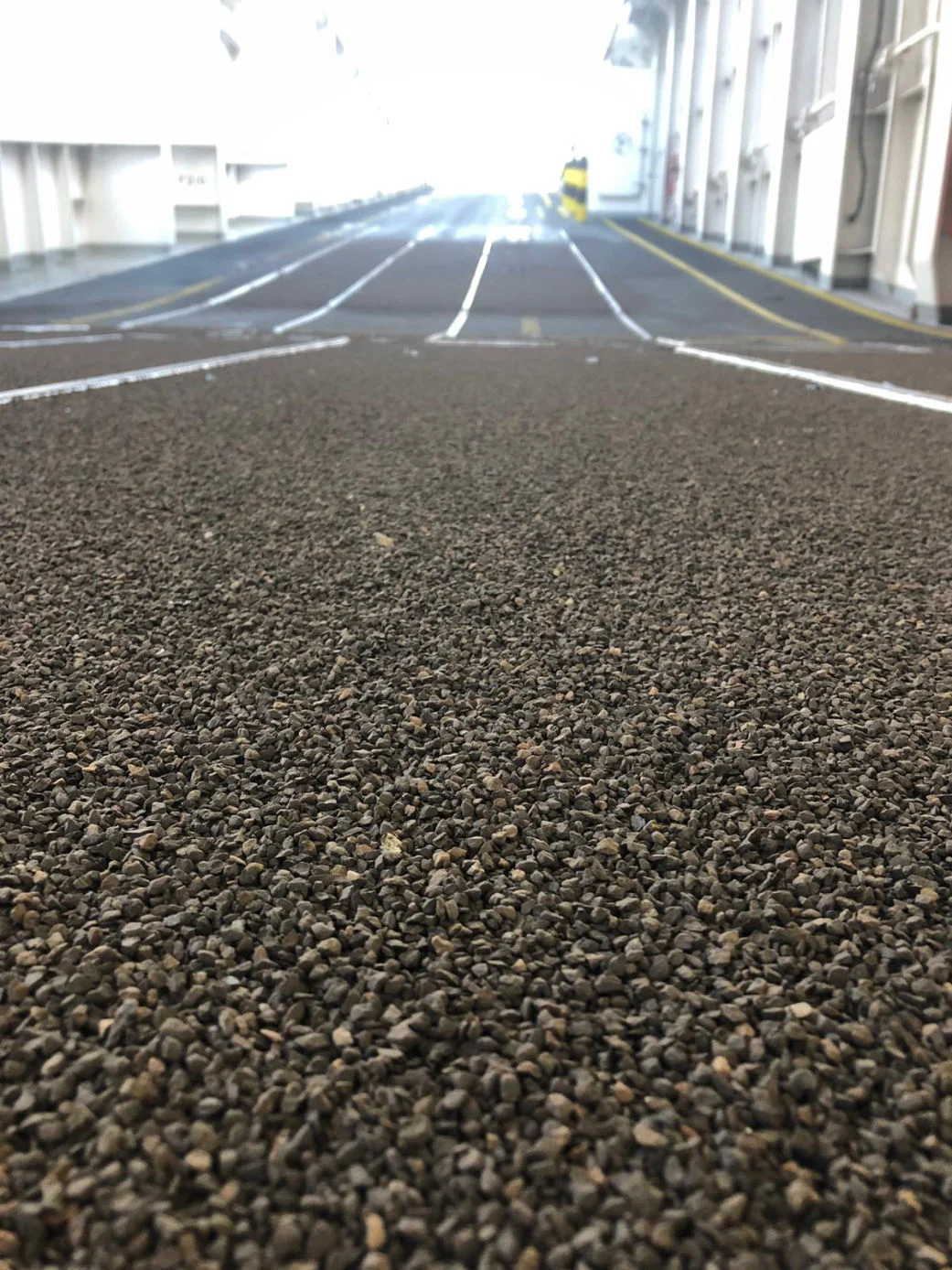
Why Do Ships Need Anti-Skid Surfacing?

Services: Non Slip Marine Deck Applications, Ship Deck Protective Paint
In the maritime industry, safety is paramount. With over 50,000 merchant vessels at sea on any given day, the need for reliable, high-performance deck surfaces has never been more critical. One vital component of ship safety is anti-skid surfacing. Not only does it prevent slips and accidents on deck, but it also plays a vital role in meeting operational and regulatory requirements.
In this Q&A, we sit down with Josh Workman, a director at WJ Marine, a leader in surface preparation and specialist anti-skid coatings. We explore why anti-skid surfacing is essential on cargo and passenger ships, the materials and techniques involved, and the latest trends shaping the industry.
Introduction
Can you start by telling us a bit about WJ Marine and your role in the company?
WJ Marine is the market leader in surface preparation and specialist anti-skid coatings, with a focus on the marine sector. The company has been in operation across Europe for the last ten years or so. Prior to joining WJ Marine, I’d worked with them as a client on several major ship deck resurfacing projects and I was very impressed with their methodical approach and the quality of their work—so much so that I ended up joining the company! I came on board as a director, seven years ago. As part of my role, I run our marine division, which focuses on surface preparation and anti-skid coatings for ships and bridges.
How long has WJ Marine been involved in ship deck preparation, and could you give me one thing that sets you apart from other services?
WJ Marine has been involved in ship deck preparation for over fifteen years. When I joined the company in 2018, we expanded our focus to include anti-skid coatings. Our combined experience in the marine industry has allowed us to develop unique expertise in the field. I believe that what truly sets us apart from our competitors is our use of specialist equipment, on-site reporting, and our ability to offer a turnkey service. We’re known for being the fastest in the industry, and our ability to handle a project from start to finish makes a big difference in ensuring high-quality results and meeting tight timelines, which is essential in this industry.
Understanding Anti-skid Surfacing
Can you explain what anti-skid surfacing is and why it is essential for ships?
Anti-skid surfacing is a type of high-friction coating applied to decks to enhance safety. It’s crucial for ships because it significantly reduces stopping distances and the risk of vehicles skidding on the deck, which is essential when loading and unloading cargo, vehicles, or passengers. The last thing you want is for a wet deck to become a slipping hazard. The anti-skid surfacing we use is lightweight, which means the vessel also uses less fuel. The coating also acts as a protective layer over the steel deck, helping to prevent corrosion and deterioration of steel thickness over time with a waterproof layer.
What types of materials or coatings are typically used in anti-skid surfacing for ship decks?
In our work, we generally use polyurethane-based coatings. These are more flexible compared to traditional rigid systems, offering about 35% more elasticity. This flexibility is particularly beneficial for steel decks that are regularly subjected to a lot of movement and stress.
How does anti-skid surfacing differ from regular deck coatings or treatments?
The main difference lies in its purpose and performance. Regular deck coatings like paints are usually formulated for corrosion protection and aesthetics, anti-skid surfacing is all about safety and functionality, as it provides enhanced grip for both people and cargo, which significantly reduces the risk of slips and accidents. It’s also designed to withstand heavy-duty wear and tear from daily operations and harsh marine environments.
Are there operational or regulatory reasons why anti-skid surfacing is important for ships?
From a regulatory standpoint, organisations like Lloyd’s Register impose strict standards on ship deck safety, which also applies to any deck coatings. These standards are designed to ensure the vessel complies with health and safety requirements.
For example, a couple of years ago, we were called in to address an issue where a ship’s ramp had been coated with a paint system that didn’t include any skid resistance, and this led to an accident. This was a UK-registered ship, so the Health and Safety Executive (HSE) stepped in to assess the situation and determined that the deck surface did not meet the required safety standards, so we were brought in to apply our anti-skid system, which passed inspection, and the ship was safe to operate again.
Fire safety is also a huge factor, so the anti-skid system must also have fire-resistant properties suitable for being out at sea. Compliance with these regulations is critical for vessels to operate legally and safely, and it’s the core focus of everything we do.
Application Process
How is antiskid surfacing applied, and what are the key steps involved in the process?
The application process is quite detailed to ensure maximum durability and safety. If there’s an old coating in place, we start by removing the old system down to the original steel or aluminium substrate. The metal is then prepared through a method called captive shot blasting, which helps create the right texture for the new coating to adhere properly. Next, a fast-curing rust-inhibiting aluminium zinc primer is applied to act as a sealant against water ingress. We then use a three-component, cold-applied polyurethane resin, which is mixed by hand and applied at the correct depth based on the type of aggregate we use. Finally, the aggregate is cast on top of the resin and, once cured, the loose aggregates are removed, leaving a nice, high-friction working surface.
What maintenance is required to keep antiskid surfaces effective over time?
Maintaining antiskid surfaces is fairly straightforward. Regular pressure washing is usually enough to keep them clean and functioning effectively. It’s important to ensure that any oils, debris, or other substances are washed away, as these can compromise the friction of the surface.
How often should anti-skid surfacing be inspected or reapplied?
This depends on the nature and volume of traffic being transported and the frequency of loading and unloading. Regular inspections by the vessel’s safety officers are essential to ensure these surfaces remain in optimal condition. In addition, we recommend that surfaces be checked every time a vessel is going into dry dock, which is typically every 3-5 years, depending on the vessel. At that point, any necessary repairs or reapplications can be made to ensure the surface remains safe and compliant or we can come during a vessel’s layover or with a supplied riding crew.
What are the challenges in applying and maintaining antiskid surfaces on ships?
One of the biggest challenges is the weather. Since the coating can’t be applied in wet conditions, rain can cause significant delays. To address this, we use our own jet dryers which we innovated ourselves which are unique to the industry, to help dry the surface if necessary. Another challenge is time. Often, the time window available for application is very tight, and we have to work efficiently to complete the job within a strict time window.
How does WJ Marine ensure that the anti-skid surfacing meets industry standards and performance expectations?
Our product is Llloyds register fire-rated approved to ensure our coatings meet all necessary standards. This includes rigorous testing and quality control to make sure that every surface we treat is both safe and compliant with industry standards.
Are there specific conditions, such as weather or operational factors, that influence the performance of anti-skid surfacing?
Yes, conditions like surface temperature and humidity play a big role. You have to know the dew point parameters on deck and monitor the humidity as you can’t apply the system if it’s above 85% humidity or below 35% humidity. And the surface temperature must be at least three degrees higher than the dew point. This ensures that the coating adheres correctly and cures properly without compromising its integrity.
Have there been any notable projects where WJ Marine’s expertise in anti-skid surfacing made a significant impact?
We recently completed work on a DFDS vessel in Felixstowe. The stern ramp needed resurfacing, but the vessel needed to remain in operation, so we broke the job down into phases. During the first phase, we stripped the old anti-skid surfacing in just seven hours, before she sailed again. We then prepared the surface using captive blasting and applied the primer overnight and the anti-skid surfacing was applied in the morning, which meant the vessel was able to remain in service throughout without any disruption to service
Industry Trends
What trends are you seeing in the industry regarding antiskid surfacing technology or materials, and how is WJ Marine adapting to service them?
One of the biggest trends is the move towards more flexible and durable materials, like polyurethane, which we use in our coatings. Chevron ribbed ramps being coated with antiskid have become increasingly popular, so we’ve adapting our equipment to suit.
Another trend we’re seeing is raised lashing points. Traditionally, lashing points were flush to the deck. To accommodate this, we’ve modified the heads on our captive shot blasting machines. Otherwise, we would have to resort to open blasting, which would slow down the surface preparation and significantly increase the cleaning process whilst not being environmentally friendly.
We’re also seeing an increase in demand for the anti-skid surfacing work to be carried out while vessels are in layover or transit. Usually, this work would be carried out while a vessel was in dry docks, but for some clients it’s far more convenient if the work can be carried out without having to wait until the vessel is in for scheduled maintenance. Again, we’ve adapted our operations to meet the needs of our clients, and we’re winning more contracts as a result. As sustainability becomes a focus globally more clients are demanding environmentally friendly coatings, which is why we use Bimagrip, because it’s durable so its whole-life carbon costs are lower. In addition, when removed, it is classed as inert waste and it’s non-hazardous, which means it’s easier to dispose of when it reaches the end of its service.
Practical Advice
What advice would you give to ship operators when it comes to choosing and maintaining antiskid surfaces?
Choosing a provider.
My advice would be to work with a provider who uses a long-standing product and has proven expertise in installations and the ever-changing marine environment. The right company should also have the flexibility to handle different situations, whether that means bringing in pedestrian machines for smaller spaces or lorries for larger deck areas. Expertise in the right equipment for all types of surfaces and conditions is essential to ensure the job is done right and on time.
Choosing aggregates.
We generally recommend using Emery as the preferred aggregate for anti-skid surfacing, as it’s got one of the highest crush resistances in the industry, ranking 9 on the Mohs scale which is just below diamond at 10. Besides its excellent impact resistance, it’s also clean and dust-free, which makes it the ideal choice for high-traffic areas. Aggregates like bauxite are also options, but they tend to have more iron silicate, which affects their impact resistance. Given that the aggregate is the first part of the system to wear down, using a tougher material like Emery ensures the surface lasts longer and maintains its skid resistance.
Surface Preparation.
It’s important to prepare the steel deck to the proper standard before applying any anti-skid coating. Ideally, the steel should be prepared to the Swedish SA 2.5 standard, which ensures that any rust is effectively removed and the right profile is achieved for the coating to bond to the surface. This preparation is crucial as the better the steel is prepared, the longer the anti-skid system will last.
Common Mistakes.
One common mistake we see in the industry is overlaying a new anti-skid surface over an old one. While this might seem like a quicker solution, if there are issues with the original surface—such as water ingress or poor adhesion—those problems will persist and could cause the new surface to fail as well along with not treating the underlying steel substrate causing further steel diminution. It also adds unnecessary weight to the deck, and more weight means increased fuel consumption, so, it’s always best to strip back to the original substrate, treat the surface to remove any corrosion, and then apply the anti-skid surface afresh.